



Blog: Threads By: John Heisz
Often, I’ll get sidetracked from the current project to work on another, if a compelling idea for some aspect of that design comes to me. It can become somewhat chaotic, having several partially finished projects in production at the same time, but I guess that’s just how I am (I usually have three of four books that I’m reading concurrently). Maybe it’s a lack of discipline. Anyway, I’ve always done things this way and I don’t expect it’ll change now.
At the best of times, these projects are like a series of threads, some even intertwine and are integral to the completion of another, to be picked up, dropped and picked up again until each is brought to a conclusion.
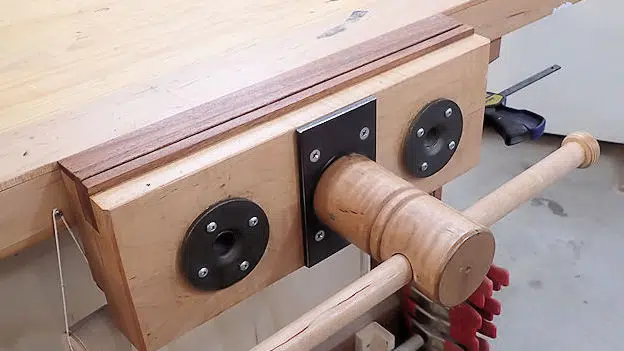
For example, while considering router lift mechanisms, I examined another possibility: a gear drive, but one that uses a worm gear as opposed to two flat gears. The benefits would be obvious, but the downside is where to get, or, more accurately, how to make a worm gear. I had a few different ideas, but I kept going back to an idea I had for cutting threads in a wood shaft. This threaded wood shaft would be just the thing for another project: a vise, naturally.
The machine for cutting the threads would be lead screw driven, very similar to how a machinist would cut a thread on bar stock. The cutter would advance
and cut the threads in the blank, which would be rotating at a rate slower than the lead screw. A gear reduction would be used between the lead screw and the stock holding shaft. A bit tricky to explain but luckily, I have pictures and video.
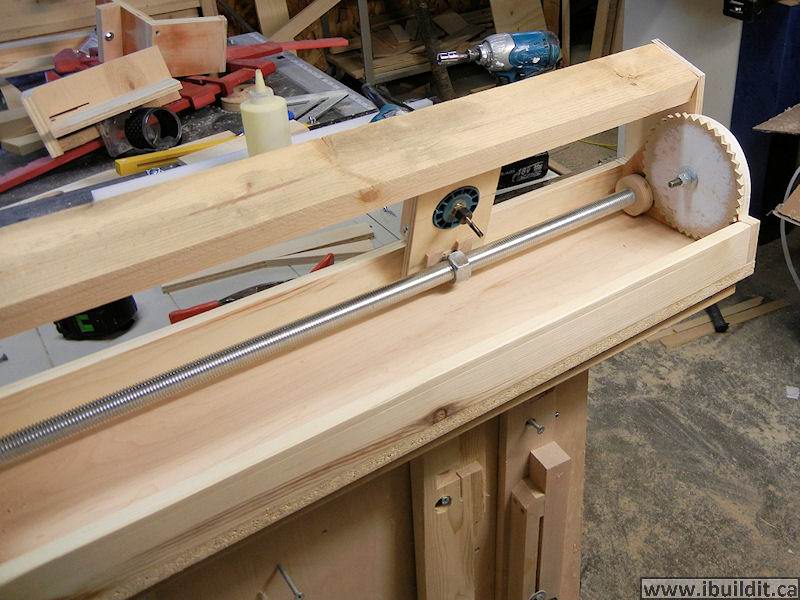
Still in the prototype stage, it does seem to work well. In the photo above, the lead screw is 1″ threaded rod, the cutter is a small laminate trimmer with a 1/4″ bit installed. The stock is threaded onto the 3/8″ bolt centred on the large gear on the end and would be supported on the other end with a live centre (similar to a lathe). Although it looks simple, it took a lot of thinking, rethinking and wrong turns to get here, believe me!
The first test:
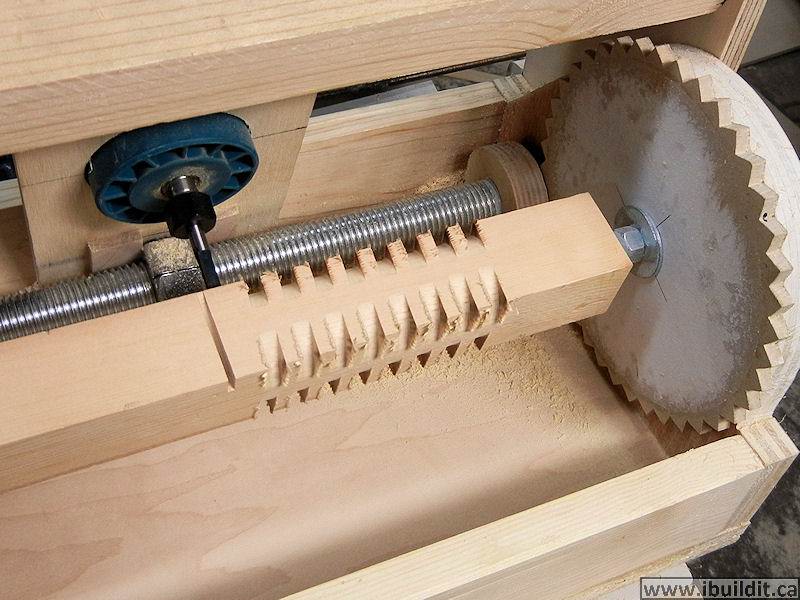
It’s set up to cut a thread pitch of 1/2″. The lead screw, being 8 tpi (threads per inch) turns four times faster than the stock. There is a 10 tooth gear on the lead screw (not seen) and that’s a forty tooth on the stock drive.
I just quickly put a piece in to give it a try and I’m pretty happy with the results. I made a short video of the fun:

I have some refinements to do on the machine, but the basic structure in there. Look for this project (and some projects that use what it produces) in the early fall.