



Blog: Saturday Night’s All Right For… Sharpening By: John Heisz
Might sound pretty boring to a twenty-something, but the evening (regardless of the day of the week) is probably the very best time for tasks that require patience, such as sharpening. I don’t spend much time on plane irons or hand chisels, since I don’t use either of these enough to justify having more than one or two of them. No, the bulk of my sharpening is on my planer blades using my sharpening rig. I’ve been working to revive the second set that I had previously tried to sharpen on the other type of jig and made a bit of a mess of. This has been a frustrating endeavor: on the first knife, it took more than an hour on the course side of my stone to reestablish the cutting edge to the point where it could be honed. Quite a workout!
On the second knife, I did something different. I thought it would be great if I had an even courser stone to quickly remove the bulk of the material, then finish it up with the regular stone. I don’t have such a stone, but I do have wet / dry sandpaper and used a piece of 220 grit right on top of the stone:
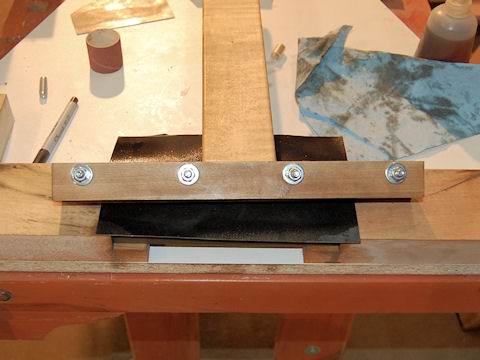
Wow, what a difference! In no time I had the angle cut down, ready for sharpening. About 5 minutes on the course side and a quick hone on the fine side and it ready to use, razor sharp. The sandpaper also slightly back-cut the angle, since it lifted the blade by the thickness of the paper, making it easier to sharpen the edge on the stone afterwards. A good trick, but one I won’t need anymore, since all four blades are now in good shape.
With these sharpened, I removed the other ones from the planer to see how they are holding up. Still very sharp, with no nicks, I gave them a quick rub on the course stone and rehoned on the fine – all in about 5 minutes. It takes longer to take them out of the planer and put them back in than it does to touch them up. Certainly, it’s a rig worth having, in my humble opinion.
Shortly after I posted the article on the sharpening rig, I saw some traffic to it from a couple of woodworking forums. Mostly good reviews, but on one the question was raised about how it might be changing the angle of the bevel. I assume the thinking was that the angle would differ across the length of the blade. Also, it was mentioned that possibly the blade would become crowned. There is some reasonable logic to this but there are other factors that seemed to have been overlooked. Let’s examine it, shall we?
First, the arc of the swing does shift the geometry of the grind, but this is of no consequence because it is so incredibly small, it would be difficult to accurately measure. The difference is in the radius from the pivot point to the middle in relation to the pivot point to the end of the blade, or about 1″. Since the arm is fairly long to begin with, and very nearly parallel to the table (zero angle) this increase in radius has an insignificant impact on the grind angle.
Second, the flatness of the grind is maintained over the length of the blade by using even, moderate pressure while grinding. This works is a way not dissimilar to the way a jointer works or a hand plane to create a flat surface. Indeed, the only way to crown the blade is by deliberately applying more pressure at the ends. Even then, this would take some effort – as demonstrated above, the stone is not cutting rapidly.
A good way to determine if you are getting a flat grind is with an accurate straightedge. Another way is to check the reflection – if it looks wavy (like a fun house mirror), then it is not flat. Tricky to do, but I took this picture of the edge reflection:
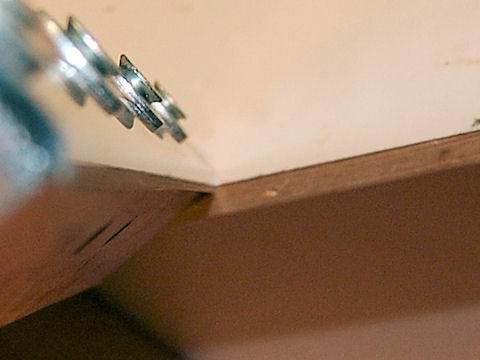
Looks pretty straight to me and confirmed with the edge of the other planer knife, when I used it as a straightedge against this one.
Heck, good enough for my woodworking projects, anyway!